What 1.8 Million Google Business Profiles Revealed About Local SEO

Whitespark, a company specializing in local SEO, analyzed 1.8 million Google Business Profiles (GBPs) spanning 4,209 categories to determine how precise category selection and complete profile fill-out affect rankings. The study was led by Whitespark founder Darren Shaw, who is also the author of this article. The findings overturn a number of assumptions local marketers hold about category selection and profile completion.
In searches for "Hair salons," the exactly matching "Hair salon" category outperformed neighboring categories such as Hairdresser, Beauty salon, Barber shop, and Nail salon — confirming that Google matches the primary category to the search term. But the study uncovered another important point: a precise, narrow category always outperforms a generic one. Averaged across all industries, businesses that chose a precise category landed in the top 10 results 12.5% of the time, versus just 9.2% for those with a generic category — a gap of nearly 36%. For example, in the legal field, "Criminal justice attorney" ranked at an average position of 44.7, while the plain "Attorney" category ranked at 57.1; among restaurants, narrow categories such as "Tapas" and "Hawaiian" reached the top 10 in 32.1% and 27.1% of cases respectively, while the generic "Restaurant" category managed only 10.1%. The reason is simple: narrow categories face less competition, and Google tries to surface the businesses that most precisely match the user's query.
After the primary category comes the turn of additional categories. The study shows that adding a specialized secondary category aligned with the primary one is associated with a ranking improvement of 6 to 17 positions. For instance, adding "Emergency veterinarian service" to the "Veterinarian" category raised the average ranking to position 33.9, compared to 51.2 without an additional category; for "Plumber," adding "Drainage service" improved the ranking to position 47.3. The authors caution, however, that this correlation is not causation — business owners who add secondary categories typically also pay more attention to local SEO overall (requesting reviews, optimizing their profile, and so on), so their strong rankings may simply reflect that broader effort. One thing is clear, though: adding a vague category nobody searches for, like "Service establishment," provides no benefit and actually hurts — profiles with such a category rank even lower than profiles with no additional category at all.
The researchers also built a 0-to-5 profile completeness index, awarding one point each for having a website URL, a business description, business hours, photos, and verified status. The results show that profile completeness varies sharply by industry: in the highly competitive home services sector, the average score was 4.4, with 55% of businesses fully filling out their profile, while in the community and organizations category, such as churches, the average score is just 3.0 and only 22% have a complete profile — because they have no competitive pressure to stand out. Most importantly, profile completeness correlates directly with ranking: profiles scoring 0 rank at an average position of 62, while profiles scoring a full 5 rank at position 43 — a 19-position gap. Even more striking, businesses with a complete profile are three times as likely to land in the top 10 (13%) as those with an empty profile (4%).
Based on these findings, Shaw offers straightforward recommendations: always choose the most precise primary category possible, add every secondary category that fits your business (while avoiding vague entries like "Service establishment"), and treat fully filling out your Google Business Profile as non-negotiable — request reviews regularly, upload photos and videos, and publish Google Posts. The author also stresses that for most businesses, optimizing the GBP alone isn't enough: you also need to improve your website from an SEO standpoint, build quality citations (references to your business on external sources), stay active on social media, and pay attention to AI SEO (improving visibility in AI-driven search systems). Whitespark plans to publish the full report in the coming days.
Related articles

The Difference Between Using AI and Being AI-Native
Using artificial intelligence tools doesn't automatically make your company AI-native — the real difference isn't about technology at all, but about how work is designed, who it's assigned to, and how it's measured.

Boosting Team Productivity with an AI Social Media Assistant
How an AI social media assistant helps social teams automate repetitive tasks, track trends, and make strategic decisions — based on Sprout Social's experience.
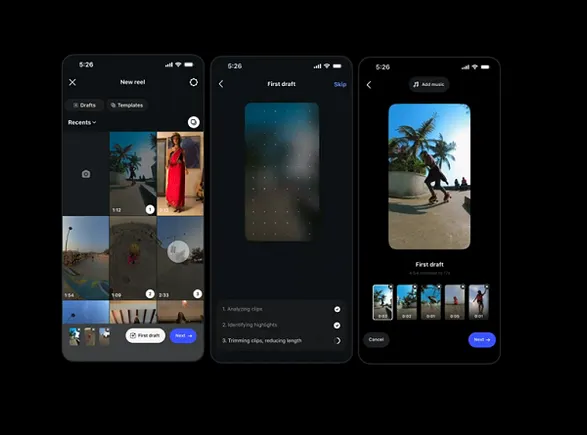
Instagram Launches First Draft Feature for Reels
Instagram has rolled out a new First Draft feature that automatically picks the best moments from multiple video clips, giving users a ready-made starting point for building Reels.