Crocs Doubles Down on Brand Storytelling With New Mascot Niles
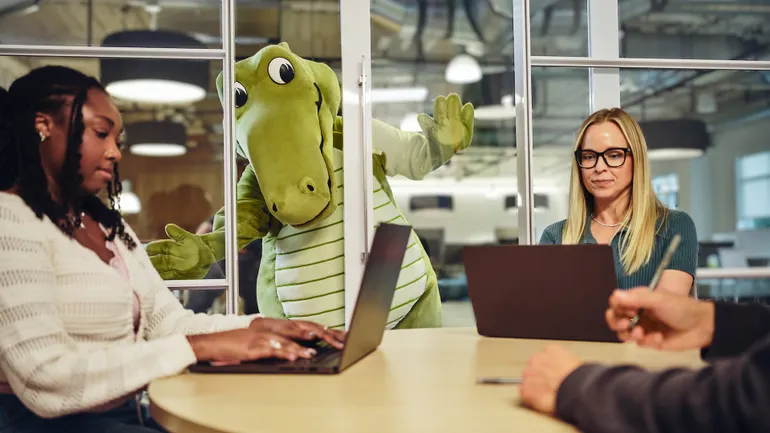
Footwear brand Crocs, ahead of its 25th anniversary, has officially unveiled a new character — a two-legged crocodile mascot named Niles. The character will play a central role in the brand's social content, events and other marketing efforts. Teased for months, Niles appears in a microseries filmed at the company's headquarters, interacting with real employees.
Niles stands nearly seven feet tall, wears Crocs clogs, and doesn't speak — but he's been given his own 'personality, interests, flaws and dreams,' a deliberate choice meant to make him a lasting part of the brand rather than a one-off ad gimmick. Crocs CMO Carly Gomes says Niles represents the brand's investment in long-term, scalable intellectual property for content, experiences and future expansion.
According to the company, the idea for Niles had actually been 'hiding in plain sight' since the brand's founding in 2002: the Crocs logo has always featured a smiling cartoon reptile, and the shoe's rounded shape echoes a crocodile's snout. The move fits a trend brands like Duolingo have used successfully — plush, oversized mascots that win viral popularity and affection with Gen Z.
Niles was first teased as a giant egg during TikTok Shop livestreams, and is now being developed with the range of a sitcom character rather than a static brand ambassador. In one clip, Niles hatches from the egg, notices the official 24-hour countdown hasn't hit zero yet, and, embarrassed, tries to put the egg back together.
Crocs is making the move against a backdrop of strong financial results: the company reported quarterly revenue above $1 billion for the first time, with second-quarter sales up 4.3%. Part of that growth is tied to activity on TikTok Shop, including the platform's first global Super Brand Day event and the shoppable microseries 'Déjà Shoe.'
Related articles
Why Is Nike Falling Behind? Don't Trust the Easy Answers
Nike's stock has hit a 12-year low, but pinning the brand's crisis on a single factor — ad spend or one political episode — misses the real picture. A Digiday analysis lays out what's actually happening.

Why AI Recommends Some Brands and Not Others: The Case for "Decision Coverage"
A SaaS brand vanished from AI recommendations for small businesses — not because of a weak reputation, but because it lacked the evidence AI needs to make a decision.

"Made by Humans": How the Strongest Marketing Brand of the AI Video Era Is Taking Shape
At a moment when social feeds are flooded with AI-generated video, brands that can prove a real person made theirs are gaining something an algorithm can never manufacture: trust.